

Lean Six Sigma Consulting in Malaysia: What Organisations Should Actually Expect
Malaysian organisations hear about Lean Six Sigma at every executive retreat and transformation conference. What consulting actually delivers, what it costs, and how to evaluate a provider remain far less clear. This cornerstone guide answers those three questions directly.

This article is written for operations heads, quality directors, transformation leads, and chief executives who are considering external consulting support and need to understand what a credible engagement looks like before signing anything.
The short version is this. Consulting is not a training roster. It is a structured programme of diagnosis, deployment, capability transfer, and governance designed to produce durable business results. When engaged well, it shifts how an organisation operates. When engaged poorly, it produces certified belts and little else. The sections that follow cover what consulting delivers, who should engage it, how engagements are priced, how to evaluate a firm, red flags to avoid, when training alone is the smarter choice, and how MBIZM Group approaches consulting engagements across Malaysia.
What Lean Six Sigma Consulting Actually Delivers
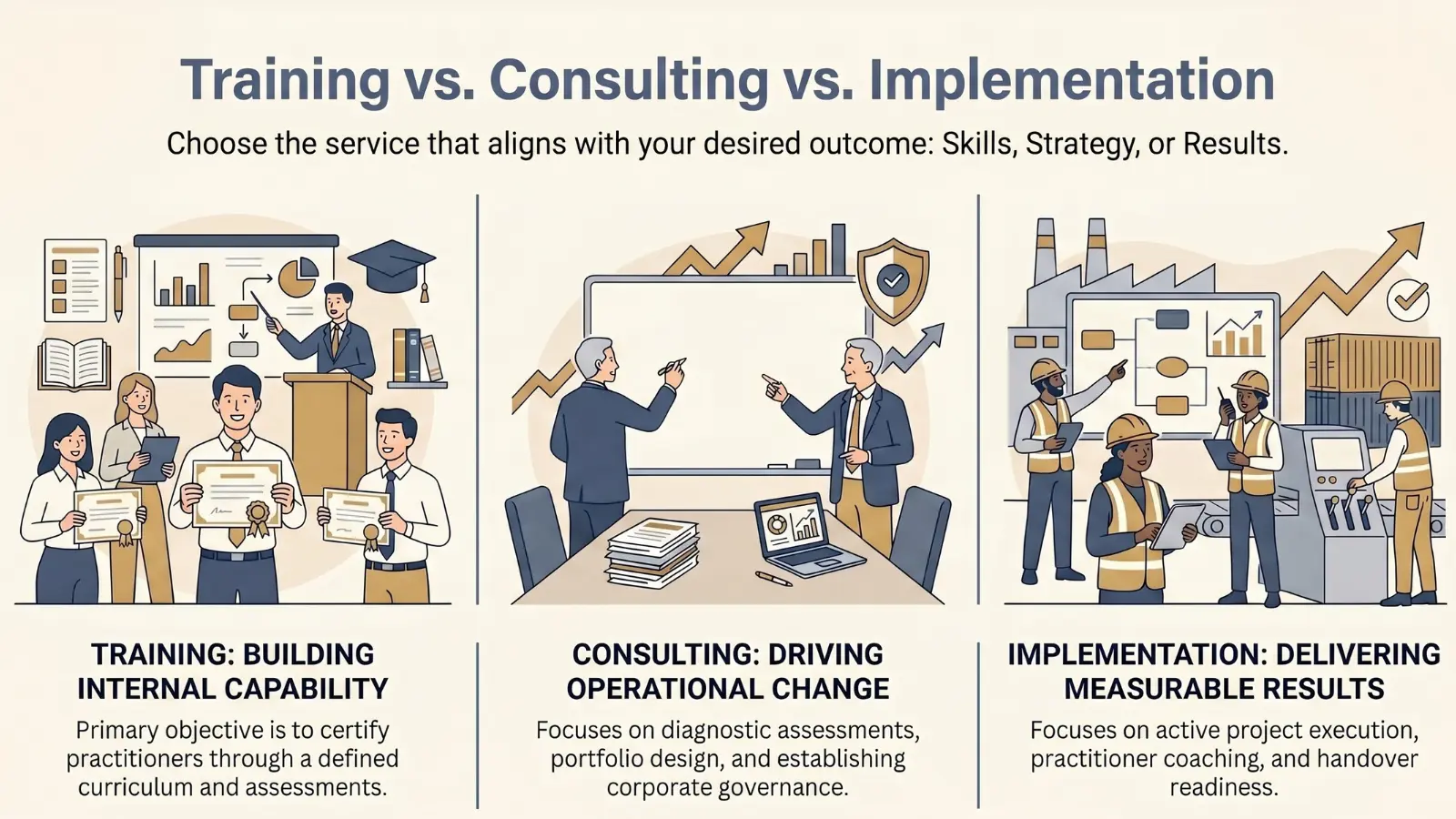
Lean Six Sigma consulting is often confused with Lean Six Sigma training, and the two operate on very different commercial models. Training produces certified practitioners. Consulting produces operational change. Malaysian organisations that blur these two categories typically buy the wrong thing.
A credible consulting scope in Malaysia usually covers the following areas:
- Diagnostic assessment of current operational performance, process maturity, and improvement capability.
- Lean maturity baseline, benchmarking where the organisation sits against the operating demands of its sector.
- Portfolio design, defining which improvement projects to run, in what sequence, and why.
- Deployment sequencing across functions, plants, business units, or geographies.
- Governance design, including steering committees, project gates, escalation paths, and reporting cadences.
- Capability transfer through live project coaching rather than classroom exercises.
- Outcome tracking, linking project results back to measurable business KPIs rather than training hours.
The contrast with pure training matters commercially. A training provider hands over a curriculum, certifies participants, and leaves. A consulting partner stays through the projects themselves, supporting practitioners, unblocking governance issues, and ensuring the organisation converts capability into results. Malaysian organisations that engage only training often find certified belts and no completed projects two years later. That execution gap is what Lean Six Sigma consulting services are designed to close.
Training, Consulting, and Implementation Support: What You Are Actually Buying
Three categories of service are routinely confused in the Malaysian market. The table below separates them so procurement conversations start from the right baseline.
| Dimension | Training | Consulting | Implementation Support |
|---|---|---|---|
| Primary objective | Certify practitioners | Produce operational change | Execute a defined deployment |
| Core deliverables | Curriculum, assessments, certification | Diagnostic, portfolio design, governance, coaching | Project execution, practitioner coaching, outcome tracking |
| Typical buyer | HR, L&D, individual practitioners | Executive sponsors, transformation leads, operations heads | Programme owners, site leaders, project sponsors |
| Typical scope | Defined cohort and duration | Organisational or multi-site | Defined project portfolio or site |
| Success measure | Certified belts | Business KPIs and capability shift | Project results and handover readiness |
| When it fits | Capability building, baseline skills | Stalled improvement, transformation mandate, turnaround | Defined deployment with leadership alignment |
All three are legitimate services, and many organisations need a mix of them across their improvement journey. The mistake is buying one and expecting the outcomes of another. If your problem is a stalled improvement programme, training alone will not fix it. If your problem is that your people do not know DMAIC, consulting is the wrong purchase.
Who Should Engage a Consultant in Malaysia
External Lean Six Sigma consulting is not always the right answer and is not always commercially justified. There are, however, specific situations where in-house effort alone is unlikely to produce the outcomes required within an acceptable timeframe.
The most common triggers for engaging external consulting in Malaysia include stalled internal improvement activity despite leadership backing, an internal capability base that is too shallow to lead complex cross-functional projects, or a transformation mandate that sits with an executive who lacks an established improvement function to execute against it. Mergers and acquisitions often produce the same need, particularly when integrating two operating models into one. Regulatory pressure in sectors such as electronics, medical devices, pharmaceuticals, and financial services is another common trigger.
Operational turnaround situations also warrant external consulting. When margin erosion, quality escapes, or customer escalations are forcing a board-level response, internal teams are rarely in a position to design and execute the intervention while continuing to run the business day to day. An external partner brings structure, capacity, and a methodology that can withstand the intensity of a turnaround programme.
Sector patterns in Malaysia tend to recur. Manufacturing organisations in automotive supply, electrical and electronics, and industrial products often engage consulting when customer quality expectations tighten or when new plant commissioning exposes process gaps. Palm oil and agribusiness operators engage when yield, recovery, or operational cost pressures make traditional practice insufficient. Services organisations, shared services centres, and back-office operations in financial services and Islamic finance engage when process variability begins affecting customer experience or regulatory metrics. GLCs and GLIC-owned subsidiaries often engage consulting alongside broader business transformation mandates that require structured governance and measurable outcomes. SMEs considering consulting usually have a specific trigger: a major customer contract, a listing preparation, or a founder-led recognition that informal process is limiting growth.
In each of these situations, the common thread is that the capability gap is larger than the internal team can close within the timeframe the business actually has.
What a Typical Engagement Looks Like
Engagement shapes vary by organisation and objective, but a credible Lean Six Sigma consulting programme in Malaysia tends to follow a recognisable arc. This section gives an overview of that arc. For a deeper view of project design, pilot structure, deployment mechanics, and capability transfer, see our detailed guide on Lean Six Sigma implementation.
See our companion article on Lean Six Sigma implementation in Malaysia, which covers pilot design, deployment sequencing, and capability transfer in detail.
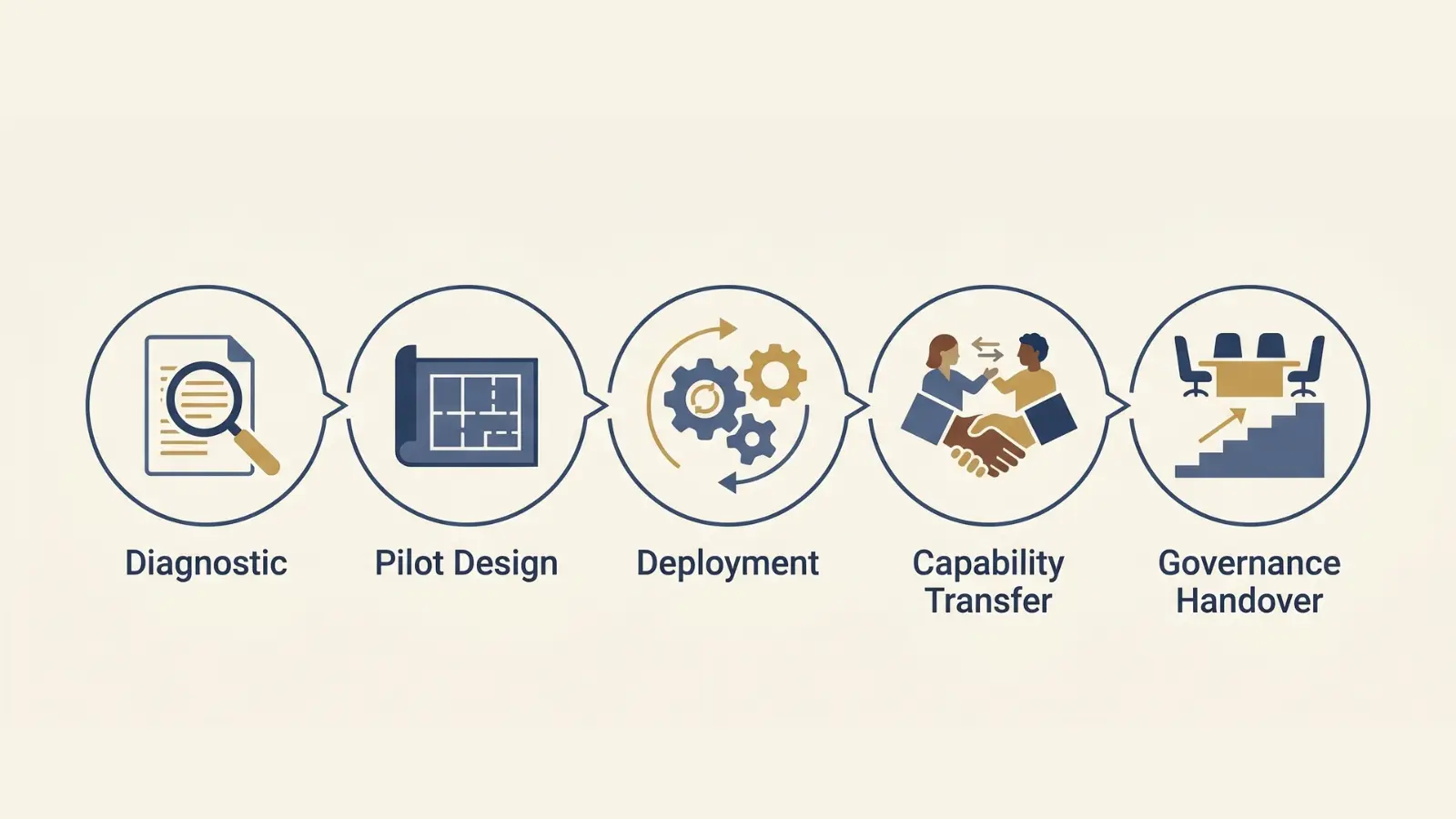
The first phase is diagnostic. The consulting team assesses current performance, interviews leadership and operational staff, reviews data, and produces a baseline. This phase is short and should be proportionate. Its purpose is to replace assumptions with evidence so the deployment design is grounded in what the organisation actually looks like.
The second phase is pilot design. A defined set of projects is selected, scoped, and prepared. Pilots are chosen for a mix of business impact and learning value. A strong pilot portfolio teaches the internal team while producing results the business can point to.
The third phase is deployment. Projects are executed with consulting support, practitioners are coached through DMAIC or similar structured methodologies, governance forums are established, and progress is reported to steering leadership.
The fourth phase is capability transfer. The consulting load reduces as internal practitioners take on greater ownership. Coaching shifts from daily involvement to periodic review.
The final phase is governance handover. The organisation inherits a working improvement system: project selection mechanisms, review forums, reporting formats, and a trained internal bench. The consultant exits when the system runs without them.
Durations depend on scope. In practice, Malaysian organisations working on single-site pilots often complete the first meaningful cycle within a defined quarter-based window, while enterprise-wide deployments run over multiple phases and can extend across several operating cycles. Any provider guaranteeing a specific timeline before conducting a diagnostic is overstating their certainty.
Commercial Expectations: Scope, Investment, and Outcomes
Commercial structures for Lean Six Sigma consulting in Malaysia generally fall into three formats, and it is worth understanding how each one behaves before procurement conversations begin.
Fixed-scope engagements price a defined set of deliverables, usually tied to a diagnostic phase or a specific project portfolio. These work well when the brief is clear, the organisational scope is bounded, and the outcomes can be articulated in advance. They protect both sides from scope drift.
Retainer engagements provide ongoing consulting capacity across a defined period. These suit organisations running multi-phase deployments where continuous coaching is part of the operating model, or where the leadership team wants access to advisory support as new improvement opportunities emerge across the year.
Hybrid engagements combine a fixed-scope kickoff, usually the diagnostic and pilot design phases, with a retained coaching layer for the deployment period. In practice, this is the most common structure for mid-market and enterprise programmes in Malaysia because it aligns cost with value creation and allows the commercial relationship to adjust as the programme matures.
Investment levels vary significantly based on scope, number of sites, project volume, depth of capability transfer, and the seniority of the consulting team assigned. Rather than publishing ringgit ranges that will mislead more than they help, the practical guidance is this. Expect the investment to be meaningful, expect it to be justified against a specific business case, and expect a credible provider to decline the engagement when the scope does not warrant the cost.
Outcomes should be framed as business outcomes, not as belt counts. The right questions at the commercial stage are: what measurable operational improvements are we targeting, what business KPIs will move, how will the results be tracked, who signs off that the outcomes have been achieved, and what internal capability will exist at the end of the engagement that did not exist at the start. A provider who cannot answer these questions confidently is not ready to be engaged. A provider who can answer them with specifics that match your organisation’s context is worth taking into a commercial conversation.
How to Evaluate a Lean Six Sigma Consulting Firm in Malaysia
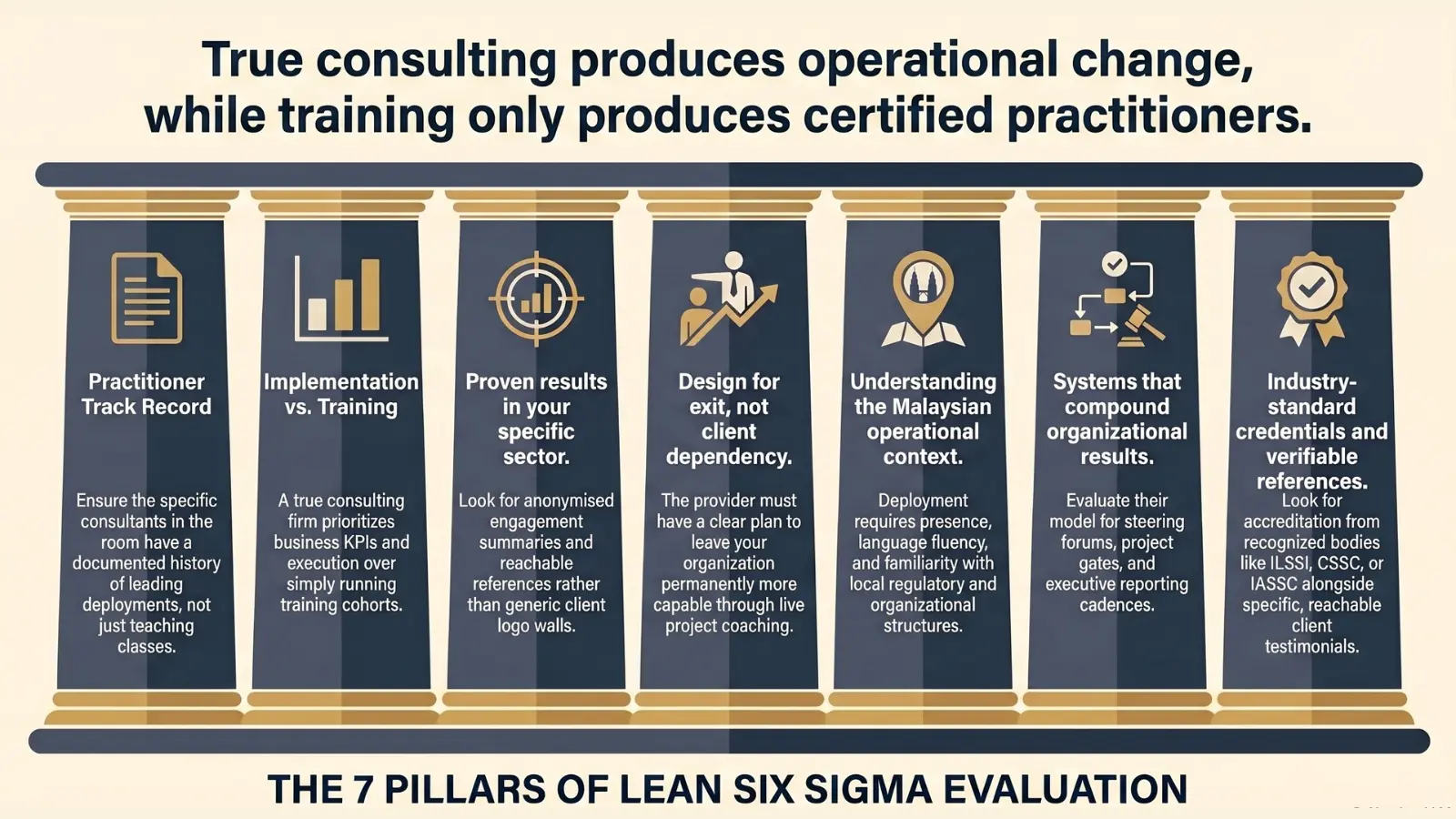
This is where most procurement processes fail. Malaysian organisations often select providers based on brochure quality, certification logos, and training day rates, then discover two years later that the engagement produced activity without outcomes. A stronger evaluation framework covers seven areas. Apply all seven before shortlisting, not after.
Practitioner Track Record
Know who will actually be in the room during your engagement. Many firms market senior partners and deliver junior facilitators. Ask for the specific CVs of the consultants who will lead diagnostic, coaching, and governance work. Look for practitioners with a documented implementation history rather than only a trainer history. MBIZM Group is led by Dr Satnam Singh, whose practitioner credentials include a PhD, ICBB, MAICD, and accreditations with bodies such as ILSSI, CSSC, and IASSC. You can also view our wider consulting team. Verifiable credentials are the minimum. Demonstrable implementation history is the real filter.
Implementation Experience Versus Pure Training Experience
A firm that has run hundreds of training batches but led few full deployments is not a consulting firm. It is a training firm positioning itself as one. Ask how many implementation engagements the firm has led, across what sectors, at what scale, and what the firm’s role was in each case. A competent consulting firm can describe specific engagement shapes, the duration of coaching support provided, and the outcomes the client organisation itself owns at the end. A training firm dressed up as a consulting firm will describe classroom cohorts and certification numbers.
Portfolio Evidence
Portfolio evidence should be specific enough to test. Named sectors, anonymised engagement summaries, articulated project types, and reachable references are stronger than generic client logo walls. Brochure proof is often the weakest area in Malaysian market pitches and is worth probing directly during shortlisting. If the provider cannot describe a past engagement in enough detail to make it credible, assume the engagement was either shallow or inherited.
Capability Transfer Model
Ask how the firm intends to leave you better than they found you. A credible capability transfer model includes coaching on live projects, mentoring internal champions, structured handover of governance, and an articulated exit plan. If the model is essentially run training, then leave, it is not capability transfer. Capability transfer is a design choice, not a byproduct, and it is visible in the way a firm structures its engagement proposal.
Malaysian Market Exposure
Lean Six Sigma methodology is portable, but deployment in Malaysian organisations runs into context-specific realities. Multi-site manufacturing, GLC governance structures, mixed-language operational workforces, regulatory frameworks, Bumiputera participation requirements on some enterprise contracts, and the operating rhythms of industries such as palm oil, electronics, automotive suppliers, and Islamic finance all shape how a programme lands. Providers without Malaysian operating experience often produce textbook deployments that stall on local realities, particularly at middle-management and floor-supervisor level where most execution happens.
Governance Approach
Strong consulting firms bring a governance model, not only a project methodology. Ask how the firm establishes steering forums, project gates, escalation paths, executive reporting, and review cadences. Governance is what separates improvement activity from improvement systems. Without governance, even good projects produce isolated results rather than compounding organisational capability.
References and Accreditation
References should be specific and reachable. Accreditation matters directionally, not absolutely. Credible bodies in the Lean Six Sigma space include ILSSI, CSSC, and IASSC. You can review our verified accreditations independently. Accreditation alone does not qualify a firm, but its absence in a market where credible accreditation is readily available is a signal worth noting. The combination of specific references, verifiable accreditation, and a named practitioner with an implementation track record is a stronger shortlist filter than any single credential by itself.
Red Flags to Watch For
Several patterns in the Malaysian market warrant caution during shortlisting. Run this list against every firm on your shortlist before commercial conversations begin.
None of these red flags is absolute. Any single one might have a reasonable explanation. Two or more in the same firm is a strong signal to keep looking.
When Consulting Is the Wrong Choice
Consulting is not always the right answer, and a credible firm will tell you so before it quotes you. This section exists to help you avoid buying consulting when training, coaching, or internal capability building would be the smarter investment.
Consider Training or Internal Capability Building If
- Your operations are stable, your quality metrics are healthy, and your leadership team is aligned on continuous improvement as an ongoing discipline rather than a change programme.
- You have a mature internal pool of Green Belts and Black Belts, a qualified Master Black Belt in the organisation, and an active project portfolio.
- Your scope is a small pilot, single-project use case, or narrow technical problem that does not warrant full consulting governance.
The honest framing is this. Consulting is commercially justified when the gap between your current capability and your required business outcomes is large enough that internal effort alone will not close it within an acceptable timeframe. If that gap is manageable, invest in capability. If it is not, invest in a consulting partner.
How MBIZM Group Approaches Consulting Engagements in Malaysia
Every consulting firm describes its approach. What matters is whether the description reflects how engagements actually run. This section outlines how MBIZM Group structures Lean Six Sigma consulting in Malaysia so you can compare our approach against the evaluation framework above.
Our engagements are led by practitioners with verifiable credentials and an implementation track record rather than a classroom-only background. Dr Satnam Singh, founder and Principal Consultant, holds a PhD, ICBB, and MAICD, with accreditations that sit within the ILSSI, CSSC, and IASSC frameworks. You can review our verified accreditations independently. We are transparent about who will be in the room during your engagement, and senior-led delivery is a structural choice, not a sales promise.
We operate across Malaysian manufacturing, electrical and electronics, automotive supply, palm oil and agribusiness, industrial and engineering services, financial services, shared services operations, and GLC-owned subsidiary environments. Our engagement shapes include diagnostic-led fixed-scope programmes, retained advisory and coaching arrangements, and hybrid deployments that combine structured kickoff with ongoing capability transfer.
Our governance model is built around steering forums, structured project gates, and executive reporting cadences that match how Malaysian leadership teams actually make decisions. Capability transfer is designed in from the first phase, not retrofitted at the end, because our exit plan begins the day the engagement starts. For a broader view of our company, team, and delivery footprint, visit the about MBIZM Group page.
Proof statements in this article have been kept directional and conservative. Specific engagement case studies, client sector detail, and anonymised outcome summaries are maintained under client-confidentiality terms and shared during commercial conversations where a non-disclosure context applies.

Next Steps for Malaysian Organisations Considering Consulting Support
If you are evaluating Lean Six Sigma consulting for your organisation, the next steps are straightforward.
Review our Lean Six Sigma consulting services to understand what MBIZM Group delivers in Malaysia. If your focus is on deployment and operational change rather than training, our Lean Six Sigma implementation page outlines how we approach structured deployment. For certification pathways, see our certification services. To speak with our consulting team, use the contact page or reach out to Dr Satnam Singh directly.
Start with a Diagnostic Conversation
Any credible engagement starts by understanding your organisation’s current situation, not by quoting a package. Arrange an initial discussion with our consulting team, or speak with Dr Satnam Singh directly to review whether external consulting fits your objectives.
Frequently Asked Questions
What does a Lean Six Sigma consultant in Malaysia actually do?
A Lean Six Sigma consultant supports organisations through diagnostic, deployment, and capability transfer rather than delivering a training curriculum. In practice, Malaysian organisations engage consultants to assess operational performance, design improvement portfolios, coach internal practitioners through live projects, establish governance, and ensure that results translate into measurable business outcomes. The consultant’s role is to leave behind a functioning improvement system, not a group of certified individuals operating in isolation. This distinction matters commercially because it changes both what you pay for and what you should expect to receive in return.
How is Lean Six Sigma consulting different from training?
Training delivers certification. Consulting delivers operational change. A training provider runs classroom sessions, assesses participants, and certifies them as Yellow Belts, Green Belts, or Black Belts. A consulting partner stays through the projects those belts are supposed to run. The consulting scope includes diagnosis, portfolio design, project coaching, governance, and outcome tracking. In Malaysia, organisations that engage training alone frequently end up with certified practitioners and no completed projects. Consulting is designed to close that execution gap through live deployment support.
What should a consulting engagement cost in Malaysia?
Investment levels depend on scope, number of sites, project volume, and depth of capability transfer. Credible providers price engagements through fixed-scope, retainer, or hybrid structures, and should be able to justify the investment against a business case. Avoid providers who quote aggressive packages without conducting a diagnostic. The right question at the commercial stage is not how cheap can this be, but what business outcomes will this produce and how will we track them. Expect meaningful investment and expect measurable return.
How long does a typical deployment take?
A single-site pilot cycle typically runs across a defined quarter-based window, while enterprise-wide deployments run over multiple phases and can extend across several operating cycles. Any firm that guarantees a specific timeline before conducting a diagnostic is overstating its certainty. Credible providers scope duration based on organisational readiness, portfolio complexity, and capability transfer goals. Short engagements can produce specific project results. Durable operational change requires longer deployment, coaching, and governance handover.
How do we evaluate a Lean Six Sigma consulting firm in Malaysia?
Evaluate across seven areas: practitioner track record, implementation versus training experience, portfolio evidence, capability transfer model, Malaysian market exposure, governance approach, and references. Ask for the specific consultants who will lead your engagement, not brochure bios. Test whether the firm’s core delivery is implementation or training. Probe case studies for detail. Request a governance model, not only a methodology. Accreditations such as ILSSI, CSSC, and IASSC matter directionally. The strongest signal is whether the firm can describe how they will leave your organisation permanently more capable.