

Implementation Strategy for Malaysia
Lean Six Sigma Implementation in Malaysia: Pilot, Deployment, and Capability Transfer
A decision-support guide for Malaysian senior managers, operations heads, quality heads, transformation leads, and CEOs evaluating what Lean Six Sigma implementation actually involves.

Lean Six Sigma implementation in Malaysia is where methodology meets operational reality. Malaysian organisations regularly commission belt training, certify a cohort of Green Belts and Black Belts, and then wonder why operational performance does not shift. The missing layer is implementation: the multi-phase programme that carries Lean Six Sigma from classroom concept into measurable business outcomes through pilot, deployment, capability transfer, and governance.
This article is written for Malaysian executives who are evaluating what Lean Six Sigma implementation actually involves before committing budget and organisational bandwidth. It is decision-support content for buyers, not training content. If you are comparing training vendors or mapping certification pathways, please use our dedicated training resources, linked later in this article.
We will cover what implementation means in Malaysian operating terms, why organisations choose to run programmes with external support, the phases that make up a credible deployment, how to design a pilot that earns executive confidence, how to sequence rollout across business units, how to transfer improvement capability internally so that gains survive consultant exit, what governance is required at each stage, what timelines and investment are realistic, and where deployments most frequently fail. By the end, you should have a clear basis for deciding whether to build an internal programme alone, bring in external implementation support, or structure a hybrid engagement.
What Lean Six Sigma Implementation Actually Means
Implementation is not training. Training builds individual capability. Certification validates that capability against an external standard. Implementation is something different. It is the orchestrated business programme that uses trained practitioners to deliver measurable improvement in real operational environments, under real commercial pressure, with governance that holds decisions in place long after the initial training dust has settled.
In Malaysian operating terms, implementation answers a specific set of executive questions. Which processes do we tackle first. Who owns each improvement project. How do we select belts for the right problems. What does sponsor engagement look like at steering-committee level. How do we hold governance discipline when month-end firefighting competes with improvement cadence. How do we measure business impact rather than counting certified belts. How do we make sure that when the external partner steps back, the internal capability can carry the programme forward.
A proper implementation includes diagnostic work to understand baseline process maturity, portfolio design to select projects that deliver business value and capability-building in equal measure, pilot execution to prove the methodology in your environment, staged deployment across business units, capability transfer so that internal practitioners can eventually run the programme without external support, and governance that survives leadership changes. The sequencing matters. Organisations that skip diagnostic and jump straight into belt training often end up with certified practitioners and no portfolio of projects to work on.
Implementation work ties closely to our Lean Six Sigma consulting services and to the broader question of what Lean Six Sigma consulting delivers for Malaysian buyers. Consulting scopes the opportunity and frames the business case. Implementation is where the work gets done. The two are complementary, not alternatives, and most serious Malaysian programmes blend the disciplines.
Why Malaysian Organisations Choose External Implementation Support
Several operating realities push Malaysian organisations toward external implementation support rather than pure in-house delivery.
The first is stalled internal improvement. Many organisations have run continuous improvement programmes, 5S initiatives, quality circles, or belt training cohorts that delivered initial momentum and then faded. External partners bring programme discipline and outside pattern recognition that internal teams cannot easily generate from within their own culture.
The second is regulatory and customer pressure. Malaysian manufacturers supplying international automotive, electronics, aerospace, medical device, and pharmaceutical customers are routinely asked to demonstrate structured process improvement maturity. Insurance, banking, and Islamic finance providers operate under regulatory frameworks where operational risk reduction carries direct supervisory interest. Implementation programmes become part of the evidence base for customer audits and regulatory reviews.
The third is transformation mandates from group leadership. When a parent company sets an operational excellence target across the Malaysian entity, the local team is often expected to stand up a programme quickly. External partners compress the learning curve and reduce the risk of false starts that consume a year of executive patience.
The fourth is mergers and acquisitions integration. Malaysian operations integrating with a newly acquired sister plant or being absorbed into a regional shared services operation need a common improvement language and method. Lean Six Sigma, deployed through a credible implementation framework, becomes a practical integration vehicle.
The fifth is industry-specific programme design. Malaysian automotive and electronics manufacturing have tight takt-time disciplines and tolerance requirements. Palm oil processing operations work with feedstock variability and seasonal throughput cycles. Islamic finance providers require method adaptation that respects Shariah governance boundaries. Services organisations, including healthcare, logistics, and BPO, deploy Lean Six Sigma on transactional rather than manufacturing process baselines. A partner that has worked across multiple Malaysian industries brings pattern recognition that a purely in-house programme takes years to build. You can review critical success factors for Lean Six Sigma process improvement for a deeper treatment of what makes these programmes land.
External implementation support does not replace internal ownership. The partner accelerates setup, reduces false starts, and transfers capability so that the internal team can eventually run the programme independently. The question is not whether to involve external support, but how to scope the engagement so that capability transfer is built in from day one.
The Phases of Lean Six Sigma Implementation in Malaysia
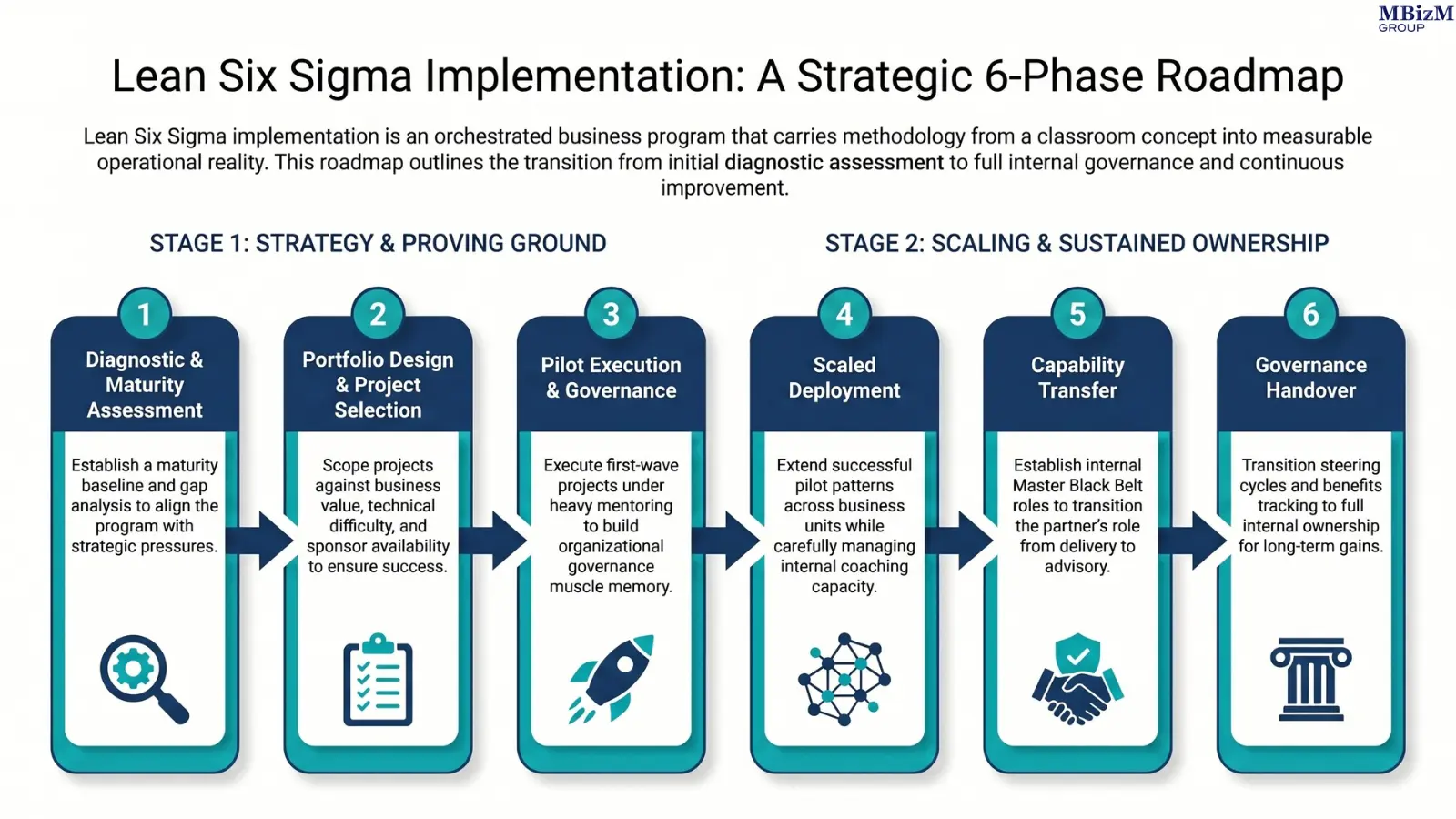
A credible Malaysian implementation moves through six phases. The phases overlap in practice. Portfolio design begins during diagnostic. Capability transfer starts during pilot. The sequencing below is the planning sequence, not a rigid waterfall.
Phase 1: Diagnostic and Maturity Assessment
The partner reviews current-state process performance, existing improvement activity, belt population, governance structures, and the strategic pressures driving the programme. Outputs include a maturity baseline, a gap analysis against expected deployment capability, and a directional view of where the highest-value projects are likely to sit. This phase rarely takes more than a few weeks, and it prevents the common failure mode of committing to a training calendar before the operating context is understood.
Phase 2: Portfolio Design and Project Selection
Candidate projects are scoped against business value, technical difficulty, belt-development fit, and sponsor availability. A proper portfolio blends quick-win projects that build programme credibility, structural projects that deliver material business impact, and capability-building projects that give belts the right problems for their certification journey. Project selection discipline is the single biggest predictor of programme success.
Phase 3: Pilot Design and Execution
The first wave of projects is executed with heavy mentoring support. Belts work live problems under coaching. Sponsors learn how to participate in tollgate reviews. Steering committees learn how to read the programme dashboard. The pilot is where governance muscle memory is built.
Phase 4: Scaled Deployment
Successful pilot patterns are extended across additional business units, functions, or plants. Rollout sequencing considers capability load on the mentoring team, business readiness, and sponsor engagement quality. Organisations that try to scale everything simultaneously typically overload the internal coaching capacity before it has been fully developed.
Phase 5: Capability Transfer and Internal Ownership
Internal Master Black Belt or lead practitioner roles are established, internal mentoring capacity is built, project review cadence moves to an internal cycle with external assurance, and the partner shifts from delivery to advisory. Capability transfer is deliberate, not accidental. It is scoped in the contract, resourced in the plan, and tracked through explicit handover milestones.
Phase 6: Governance Handover and Continuous Improvement
The steering committee cycle, belt development pipeline, project selection discipline, and benefits tracking system are transitioned to full internal ownership. The external partner may remain involved through periodic reviews, capability audits, or targeted intervention on high-stakes projects, but programme leadership now sits internally. This is where implementation becomes continuous improvement and where the return on the original consulting investment begins to compound. Patterns from organisations that have sustained these programmes are worth studying, as covered in our review of companies that have successfully implemented Lean Six Sigma.
The phase sequence matters, but so does the discipline inside each phase. Malaysian programmes that treat phase transitions as diary events rather than capability checkpoints often find themselves in Phase 4 deployment without the Phase 2 portfolio discipline or Phase 3 governance muscle memory that the scaled rollout assumes. A proper phase review asks not just whether the calendar has advanced but whether the readiness conditions for the next phase have actually been met.
For Malaysian organisations planning their first major implementation, the diagnostic and portfolio design phases are the phases most commonly under-resourced and most commonly regretted. Spending properly here compresses the cost and time of every phase that follows.
Pilot Design: Getting the First Wave Right
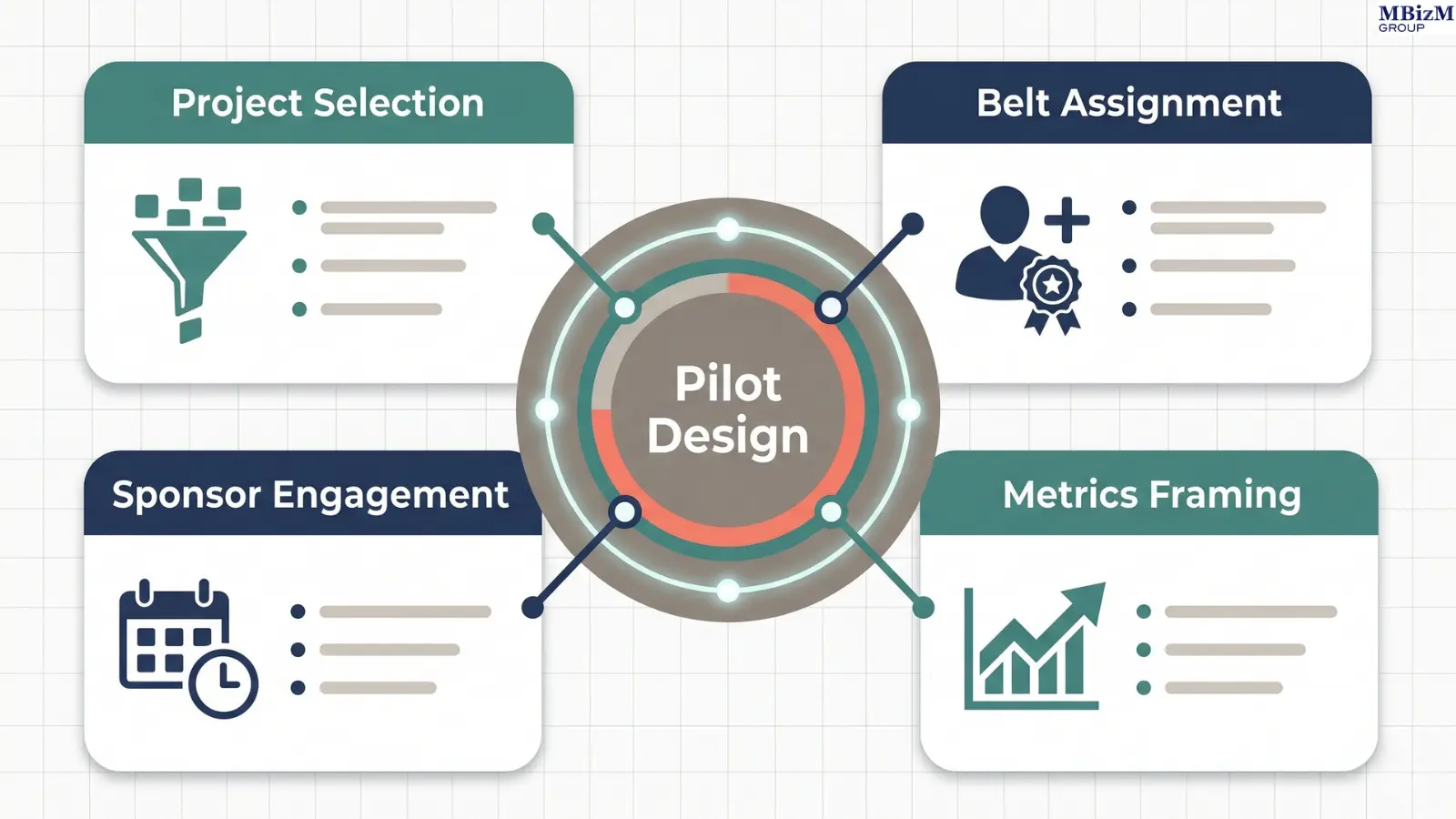
The pilot is not a training exercise. It is the first opportunity to demonstrate that Lean Six Sigma implementation in Malaysia delivers real business outcomes in your operating environment, and the first opportunity to embed the governance habits that will carry the scaled programme.
Project selection criteria for a pilot should be deliberately tilted. Pilot projects must be solvable within the target cycle time, typically four to six months for a Black Belt project and three to four months for a Green Belt project in Malaysian operating environments. Pilot projects must have accessible data. Pilot projects must have a real sponsor who will commit to fortnightly or monthly reviews. Pilot projects must deliver a business outcome that executive stakeholders will recognise as material.
Belt assignment matters as much as project selection. The right belt for a pilot is not necessarily the most technically gifted. It is a belt with organisational credibility in the business area, sponsor access, and the capacity to navigate cross-functional obstacles. A technically strong belt working in a politically awkward situation with a disengaged sponsor rarely produces the result that the pilot is designed to demonstrate.
Sponsor engagement is where many Malaysian pilots are lost. Sponsors who delegate the improvement agenda to their quality or continuous improvement function, rather than owning it visibly, send a signal that the methodology is a staff-function exercise. Sponsors who attend tollgate reviews, question the analysis, challenge the recommendation, and approve the implementation plan send a very different signal. The coaching conversation with sponsors during pilot is one of the most important interventions the external partner delivers.
Metrics framing during pilot sets precedent for the wider programme. A pilot that reports belt certification progress as its headline metric teaches the organisation that certification is the goal. A pilot that reports process performance improvement, cost-out, cycle-time reduction, customer-impact metrics, or regulatory-risk reduction teaches the organisation that business outcomes are the goal. The first few tollgate reviews shape how every future project will be reviewed.
A well-designed pilot produces three deliverables beyond the project outcomes themselves. It produces a validated project framework that the organisation trusts. It produces governance muscle memory that the steering committee can rely on. And it produces credibility capital that the programme can spend to secure Phase 4 deployment budget and sponsor time.
From Pilot to Deployment: Sequencing for Scale
Pilot success does not translate automatically into deployment success. The sequencing from pilot to scaled rollout is one of the more commonly mishandled transitions in Malaysian programmes.
Deployment rollout patterns fall into three common shapes. Sequential rollout takes the pilot pattern and applies it unit by unit, with each new business unit joining after the previous one has been stabilised. Parallel rollout runs multiple business units simultaneously, which compresses timeline but stresses coaching capacity. Hybrid rollout anchors each new wave around a core coaching team while staggering business unit entry. The right pattern depends on coaching capacity, business unit readiness, and the risk appetite of the steering committee.
Coaching capacity is the most commonly underestimated constraint. An experienced Master Black Belt or senior consultant can meaningfully coach perhaps six to ten live projects at any one time. Beyond that, coaching quality degrades, tollgate discipline slips, and projects begin to drift. Malaysian programmes that plan rollout based on training capacity rather than coaching capacity routinely discover the constraint only after the third wave is already in progress.
Business unit readiness varies more than most programme designs acknowledge. A pilot business unit with a strong sponsor, engaged quality function, and live data systems is a very different starting point from a business unit with a reluctant general manager, a lean quality team, and manual data collection. Deployment sequencing should protect weaker business units by bringing them in after stronger units have built programme momentum and after the coaching team has absorbed lessons from the earlier waves.
Common deployment failures in Malaysian programmes include training-calendar-led rollout where certification cohorts are scheduled without a matched project portfolio, sponsor fatigue where early enthusiasm fades as routine business pressure returns, governance collapse where steering committee cadence becomes monthly, then quarterly, then dormant, and capability-transfer deferral where the external partner carries the coaching load for so long that no internal mentoring capability ever develops.
What prevents these failures is treating deployment as a programme rather than a calendar. A programme has portfolio discipline, coaching capacity planning, governance cadence protection, and an explicit capability transfer track. A calendar just has training dates. Organisations that invest in portfolio and coaching during deployment typically reach Phase 5 capability transfer earlier, with better internal bench strength, than organisations that run faster but shallower rollout. Patterns emerging from integrated methods are worth exploring in our note on integrating Lean Six Sigma, Design Thinking and Agile.
Capability Transfer: Making Improvement Internal
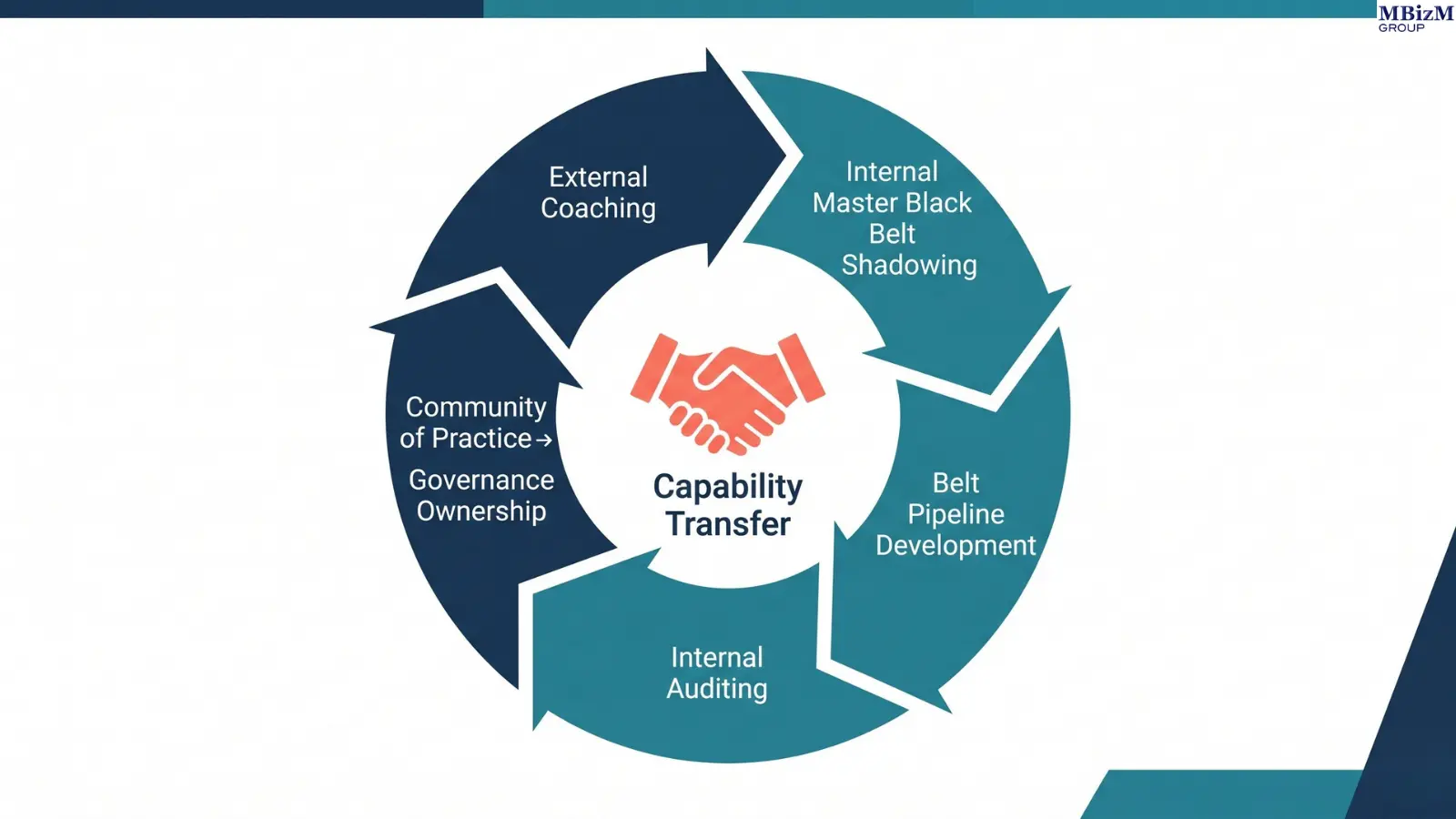
Capability transfer is the mechanism that makes consulting engagements pay back for years after the consultant leaves. An implementation programme without an explicit capability transfer track eventually degrades, because the organisational muscle required to run the methodology lives in the external partner rather than the internal team.
A proper capability transfer design has several components. An internal Master Black Belt or senior improvement lead is identified early, not appointed at the end. This person shadows the external coaching team through pilot and early deployment, co-facilitates tollgate reviews, and gradually takes over project mentoring during Phase 4. By the time deployment reaches its later waves, internal coaching capacity is meaningfully substituting for external coaching capacity.
A belt development pipeline is established that produces a steady supply of practitioners across Green Belt, Black Belt, and eventually Master Black Belt levels. This pipeline is connected to project portfolio. Belts are developed against real improvement problems, not against synthetic case studies. Certification is a milestone within development, not the endpoint. Organisations that treat certification as the endpoint typically produce certified practitioners who cannot navigate real-world project work. You can explore LSS certification pathways and our team of consultants who design them.
Internal auditing capability is built, so that project quality, methodology adherence, and governance discipline can be assessed without external assurance on every project. Auditing is initially conducted jointly with the external partner and then transitioned to full internal ownership during Phase 5.
A community of practice is established for internal belts. Monthly forums, peer mentoring networks, lessons-learned libraries, and project showcase events keep the methodology alive between formal training cohorts. The community of practice is particularly important in Malaysian programmes where belts may sit in geographically separated plants or in business units with limited natural crossover.
Finally, governance ownership shifts explicitly. The project approval flow, belt assignment process, sponsor engagement cadence, benefits tracking system, and continuous improvement policy all move from shared or partner-led ownership to full internal ownership. This shift is visible in programme documentation, not just in practice. Programmes that leave governance documentation in draft or in partner templates typically experience governance drift when the partner steps back.
Capability transfer is a design discipline, not a wind-down activity. It is scoped into the engagement from day one and tracked through explicit milestones.
Governance and Measurement Through the Programme Life Cycle
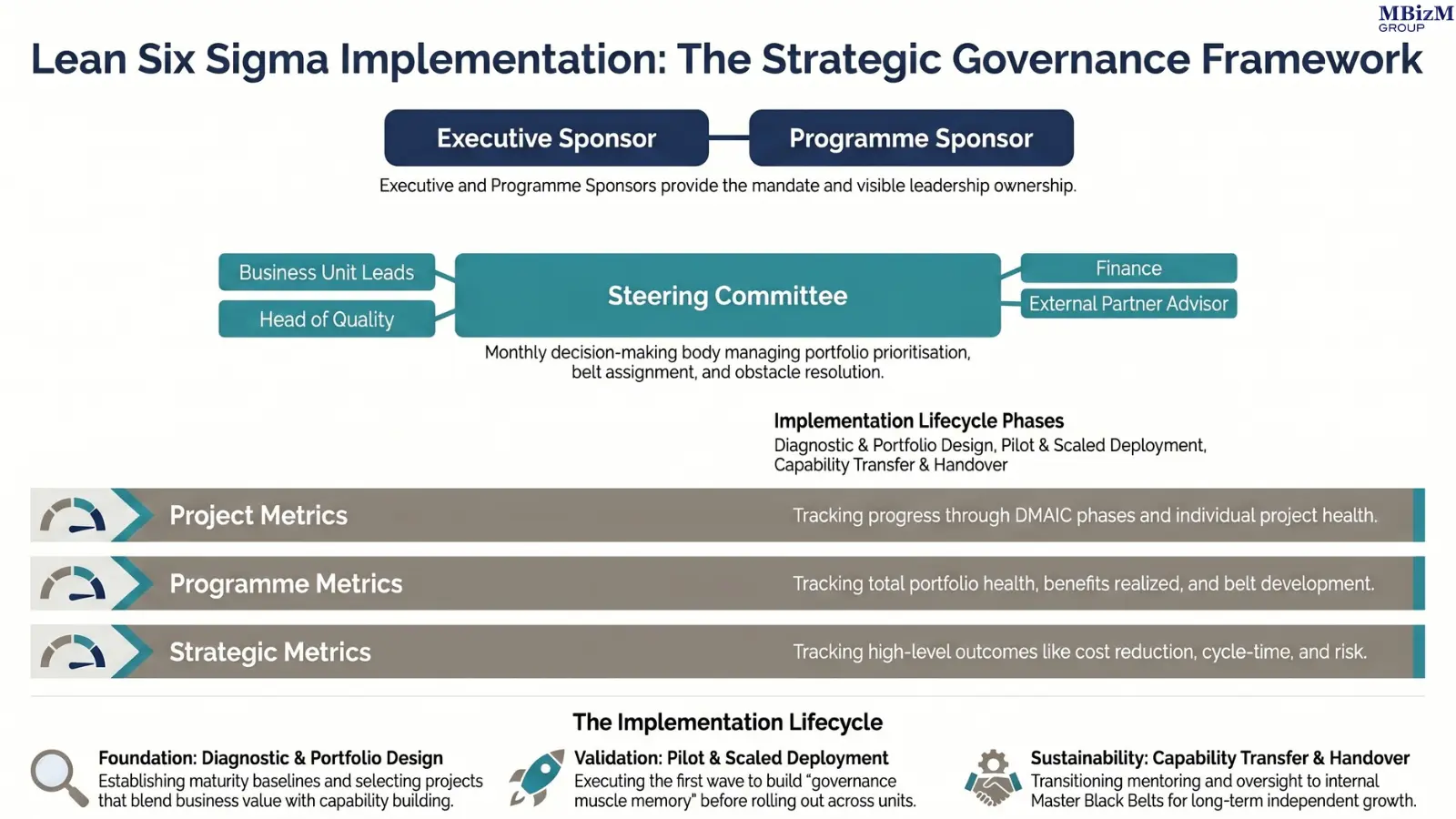
Governance is what separates a Lean Six Sigma programme from a collection of improvement projects. Without governance, projects drift, benefits erode before they are realised, and organisational attention moves to the next priority before the methodology takes root.
The steering committee is the core governance body. A Malaysian steering committee typically includes the executive sponsor, the programme sponsor, business unit leads, the head of quality or continuous improvement, finance representation for benefits validation, and the external partner as advisor. The committee meets monthly during active deployment, with decision rights over portfolio prioritisation, belt assignment, benefits validation, and cross-functional obstacle resolution.
Metrics cadence should run at three levels. Project-level metrics track individual project progress through Define, Measure, Analyse, Improve, Control phases. Programme-level metrics track portfolio health, including active projects, closed projects, benefits realised, benefits in pipeline, and belt development status. Strategic-level metrics track the business outcomes the programme is designed to deliver, whether cost reduction, cycle-time improvement, defect-rate reduction, customer-satisfaction improvement, or regulatory-risk reduction.
Stage gates between phases are essential. Phase 1 to Phase 2 transition requires a validated diagnostic and a signed portfolio framework. Phase 3 to Phase 4 transition requires pilot project completion with validated business impact and sponsor feedback. Phase 4 to Phase 5 transition requires demonstrated internal coaching capability and documented governance processes. Stage gates treated as calendar events rather than readiness checkpoints are the mechanism by which programmes drift into Phase 4 with Phase 2 gaps.
Executive reporting should be concise and consistent. A one-page programme dashboard reviewed monthly at the steering committee level, a quarterly executive review that connects programme results to strategic objectives, and an annual programme review that reassesses portfolio direction, capability gaps, and investment levels. Reporting that swells to fifty-slide decks typically signals that nobody is reading them.
Benefits validation is where many Malaysian programmes lose credibility. Claimed project benefits that cannot be validated by finance undermine executive confidence in the entire programme. A benefits validation protocol, jointly owned by programme leadership and finance, run at project closure and again six months post-closure, protects programme credibility and supports honest executive reporting.
Governance discipline in Months Six through Twelve of a programme is typically the best predictor of whether the programme will still be active in Year Three.
Commercial Expectations: Timelines, Investment, and Outcomes
Commercial expectations for Malaysian implementation programmes vary widely with scope, scale, industry, and starting maturity. The directional ranges below are offered as planning references, not as price quotations. A proper proposal requires scoping conversation and diagnostic, which can be arranged through our implementation services.
Typical engagement duration for a full implementation, from diagnostic through Phase 5 capability transfer, runs between twelve and thirty-six months. Programmes at the shorter end are typically single-site, single-business-unit deployments with strong starting maturity. Programmes at the longer end are multi-site, multi-business-unit deployments or enterprise-wide transformation efforts. Most Malaysian mid-market programmes sit in the eighteen to twenty-four month range for first-wave capability transfer, with Phase 6 continuous improvement extending indefinitely as an internal programme.
Investment framing depends on scope, not on a per-unit training price. A credible implementation proposal frames investment across diagnostic, portfolio design, pilot delivery, deployment coaching, capability transfer, and governance advisory. Training costs are a component of the proposal, not the headline. Malaysian buyers who commission proposals against a per-head training price typically end up comparing training-focused vendors against implementation-focused partners on a metric that favours the wrong answer.
Outcomes should be framed against business results, not belt counts. A programme that certifies fifty Green Belts and delivers no validated business benefit is a failed programme. A programme that certifies fifteen Green Belts and delivers documented, finance-validated business benefits against strategic objectives is a successful programme. Boards and executive committees should be asking for benefits validation reports, not belt population reports. Directional patterns are visible in client success stories across Malaysian and regional deployments.
Payback expectations in Malaysian manufacturing and services environments typically emerge between Month Nine and Month Eighteen, with compounding returns as Phase 5 and Phase 6 take hold and internal capability begins to generate improvement without external input. The return on external implementation investment should therefore be measured over a three-year horizon, not a twelve-month horizon, to capture the compounding effect of capability transfer.
For Malaysian organisations evaluating multiple proposals, the question to ask is not “how much does it cost.” It is “what does your proposal say about capability transfer by Month Eighteen and what does your proposal assume about governance survival after Month Twenty-Four.”
What Fails Most Often in Malaysian Deployments
Common failure modes recur across Malaysian implementation programmes. Recognising them in advance prevents most of them.
Tooling-first thinking is the most common early-stage failure. Organisations invest heavily in software, dashboards, and statistical packages before establishing the methodology fundamentals. Tools without discipline produce dashboards that nobody reads and statistical outputs that nobody trusts. Discipline first, then tools.
Weak sponsor engagement is the most common mid-programme failure. Sponsors who attended the kickoff but delegated the rest of the programme to the quality function send a signal that the programme is not real executive priority. Recovering sponsor engagement after it has lapsed is significantly harder than establishing it at the outset. The coaching conversation with sponsors is as important as the coaching conversation with belts.
Belt programmes without projects is a well-documented failure mode. Organisations that run belt training cohorts without a parallel project portfolio end up with certified practitioners and nothing for them to work on. Certification momentum fades, practitioners lose engagement, and the investment in training does not convert into business benefit. Portfolio before cohort is a non-negotiable discipline.
Governance collapse after consultant exit is the most common late-programme failure. Steering committee cadence drifts from monthly to quarterly to dormant. Stage gates that were rigorous during external partner involvement become paper exercises. Benefits validation lapses. The programme remains on the org chart but stops delivering. Preventing this requires explicit capability transfer for governance, not just for coaching.
Metric drift is the quiet failure. Programmes that started with business-outcome metrics gradually drift toward belt population, project count, and training hour metrics because those metrics are easier to report. By Year Two, the monthly executive update reports belt counts and nobody asks about business impact. Reversing this drift is possible but requires executive insistence on benefits-first reporting.
Culture-language mismatch is the underrated failure mode in Malaysian multinational entities. A programme designed in a parent-company cultural context may not land cleanly in the Malaysian operating culture. Method adaptation to local decision-making norms, escalation norms, and hierarchy respect is part of credible implementation design.
When to Bring in External Implementation Support
Not every Malaysian organisation needs external support for Lean Six Sigma implementation in Malaysia. The decision framework below helps clarify when the investment is justified.
External implementation support is typically justified when: the organisation is standing up Lean Six Sigma for the first time and needs to compress the learning curve; an existing internal programme has stalled and needs outside pattern recognition to diagnose why; a transformation mandate requires programme delivery inside a timeline that internal capability cannot currently support; industry-specific deployment patterns matter and the internal team does not yet have the exposure; capability transfer targets require a structured handover design rather than ad-hoc coaching.
External implementation support is typically less justified when: the internal programme is mature, well-governed, and delivering measurable benefits; the strategic need is incremental improvement rather than programme acceleration; the immediate requirement is narrow-scope training rather than full implementation design. In these situations, our certification services or targeted advisory engagements may serve the need better than a full implementation engagement.
Hybrid engagements are increasingly common in Malaysian mid-market organisations. The partner provides diagnostic, portfolio design, pilot coaching, and capability transfer framework. The internal team executes deployment coaching, governance cadence, and continuous improvement. This pattern optimises the value of external expertise while protecting internal ownership from day one.
Organisations weighing this decision often benefit from reading our companion piece on consulting engagement expectations, which covers the consulting decision framework that sits alongside the implementation decision framework presented here. The two decisions are related but distinct. Consulting scopes the opportunity. Implementation delivers against that scope. Most serious Malaysian programmes benefit from both.
Next Steps for Malaysian Organisations Planning Implementation
Organisations planning a Lean Six Sigma implementation in Malaysia should begin with three practical steps.
First, establish internal clarity on what success looks like. Define the business outcomes that the programme must deliver within eighteen to twenty-four months. Identify the strategic pressures, regulatory requirements, customer demands, or transformation mandates driving the investment. Write these down before speaking to external partners.
Second, scope the diagnostic conversation. A reputable implementation partner will not propose a programme without a diagnostic phase. Be prepared to invest several weeks in diagnostic work before committing to a multi-year deployment budget. The diagnostic is where the programme shape is determined.
Third, open the conversation. You can contact our team to arrange an initial implementation discussion with Dr Satnam Singh or one of our senior consultants. Early conversations are scoping conversations, not sales pitches. The right questions in the first meeting are about your operating context, your strategic objectives, and your capability-transfer ambitions, not about training schedules.
For broader context on our firm, you can read about MBIZM Group and review our verified credentials and accreditations, including ILSSI, CSSC, IASSC, and PeopleCert IASSC. For training and certification enquiries, please use the dedicated site linked in the section below.
Discuss Your Implementation with MBIZM Group
If you are evaluating Lean Six Sigma implementation for your Malaysian organisation, we can arrange a scoping discussion with Dr Satnam Singh or one of our senior consultants.
Looking for Lean Six Sigma training and certification instead?
For course schedules, Green Belt and Black Belt programmes, online certification routes, and enrolment details in Malaysia, visit our dedicated training site at sixsigma.com.my.
Frequently Asked Questions
-
What does a Lean Six Sigma implementation look like in a Malaysian company?
A Lean Six Sigma implementation in Malaysia typically moves through diagnostic, portfolio design, pilot execution, scaled deployment, capability transfer, and governance handover phases. It involves a mix of trained belts, sponsored projects, steering committee discipline, and finance-validated benefits tracking. Duration ranges from twelve to thirty-six months depending on scope. The programme engages executive sponsors, operational leaders, the quality or continuous improvement function, and selected belts across business units. Implementation delivers measurable business outcomes, not just certified practitioners. Industry context shapes the design, with manufacturing, services, financial services, and Islamic finance programmes each requiring tailored methodology application.
-
How long does a pilot phase typically take?
A pilot phase in a Malaysian Lean Six Sigma implementation typically runs between four and six months from project selection to completion. Green Belt pilot projects often close in three to four months. Black Belt pilot projects often close in four to six months. The pilot phase duration reflects project scope, data accessibility, sponsor engagement cadence, and the time required to build governance muscle memory. Pilots that run significantly shorter often lack the depth to demonstrate the methodology credibly. Pilots that run significantly longer typically signal project selection or sponsor engagement issues that need to be addressed before deployment scales further.
-
What fails most often during Lean Six Sigma deployment?
The most common deployment failures in Malaysian programmes are tooling-first thinking, weak sponsor engagement, belt programmes without matched project portfolios, governance collapse after external partner exit, metric drift from business outcomes toward belt population, and culture-language mismatch in multinational entities. Each failure mode is preventable with deliberate design. Tooling discipline, active sponsor coaching, portfolio before cohort, governance capability transfer, benefits-first reporting, and cultural adaptation of methodology application are the countermeasures. Programmes that treat the first twelve months as training delivery rather than as programme design are most at risk across every failure mode.
-
How do we transfer capability internally after a consulting engagement?
Capability transfer is designed from day one of the engagement, not added at the end. An internal Master Black Belt or senior improvement lead shadows the external coaching team through pilot and early deployment, progressively taking over project mentoring. A belt development pipeline is established, connected to a real project portfolio. Internal auditing capability is built so that project quality can be assessed without external assurance on every project. A community of practice keeps the methodology alive between training cohorts. Governance ownership shifts explicitly from shared or partner-led to full internal ownership, documented in programme materials.
-
What governance is needed between pilot and full rollout?
Pilot-to-deployment governance requires a functioning steering committee with decision rights over portfolio, belt assignment, and benefits validation. Monthly steering committee cadence during active deployment, project-level and programme-level dashboards, finance-validated benefits tracking, stage gates between phases, and clear sponsor engagement protocols are the core elements. Stage gates must operate as readiness checkpoints, not calendar events. Programmes that deploy without resolving governance gaps from pilot frequently discover those gaps in Phase 4 when multiple business units are active simultaneously and coaching capacity is already loaded. Governance discipline in the first twelve months is the strongest predictor of programme survival.
-
What is the typical investment required for a Malaysian deployment?
Investment in Malaysian Lean Six Sigma implementation varies widely with scope, scale, industry, and starting maturity. Credible proposals are framed across diagnostic, portfolio design, pilot delivery, deployment coaching, capability transfer, and governance advisory components, not against a per-head training price. Programme duration from twelve to thirty-six months drives the total envelope. Payback typically emerges between Month Nine and Month Eighteen, with compounding returns as capability transfer takes hold. Organisations should evaluate return on implementation investment over a three-year horizon, not a twelve-month horizon. A scoping conversation and diagnostic phase are required before any reliable investment estimate can be given.